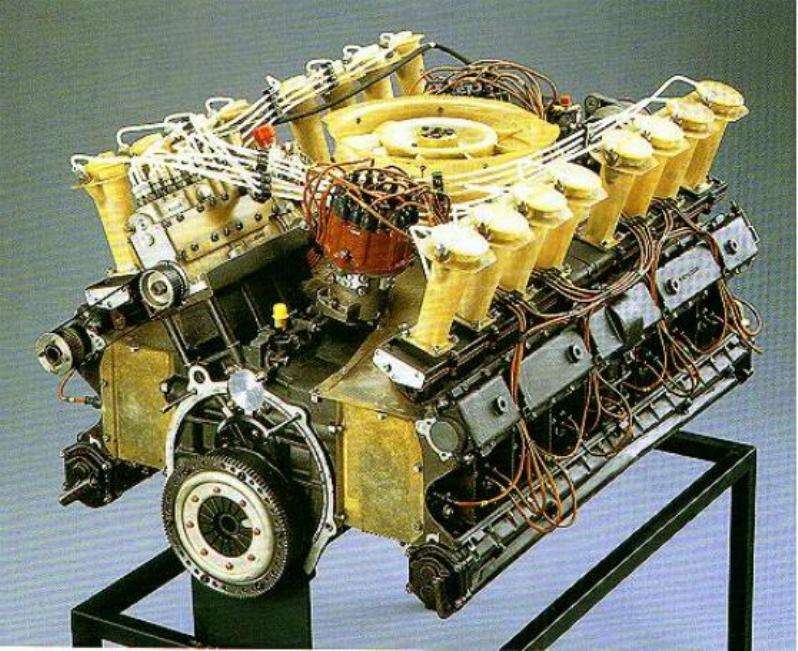
Ok amigos, vamos por partes...
El angulo a 180? no define una "V" y de hecho nunca he hablado de motor en "V a 180?" sin embargo, la definici?n que yo tampoco comparto, se usa y la he encontrado en varios sitios...
No se trata de una teor?a "m?a", ni siquiera del Ing. Forghieri, la denominaci?n "Boxer" es anterior y surge mucho tiempo antes...
Me permito hacer esta citaci?n, a ver si se aclara el concepto, la confusi?n no deriva del n?mero de cigue?ales, sino de la forma como en estos motores, los cilindros opuestos se conectan al cigue?al, esta en ingl?s y la dejo en ingl?s para no alterar su claridad:
Usually, each pair of corresponding pistons from each bank of cylinders share one crank pin on the crankshaft, either by master/slave rods or by two ordinary rods side by side. Some authorities divide flat engines into boxer engines which do not share crank pins in this way, and 180? engines which do.
The boxer engine (also known as a horizontally opposed cylinder engine) in which the corresponding pistons reach top dead center simultaneously. Boxer engines should not be confused with opposed piston engines, which use a completely different concept.
The 180? V engine, in which corresponding pistons share a crank pin on the crankshaft, and thus each will reach top dead center half a crankshaft revolution after the other. Flat engines with more than eight cylinders are most commonly V engines.
Boxer engines got their name because each pair of pistons moves simultaneously in and out rather than alternately, like boxers showing they're ready by clashing their gloved fists against each other before a fight. Boxer engines of up to eight cylinders have proved highly successful in both automobiles and motorcycles, and continue to be popular for light aircraft engines.
One benefit of using a boxer engine versus a V-engine is that the design provides good balance because each piston's momentum is counterbalanced by the corresponding piston movement of the opposite side. Boxers are one of only three cylinder layouts that have a natural dynamic balance...
This configuration is sometimes termed a 180? V engine because like most other V engine layouts each pair of pistons share a crank pin. In a 180? V engine when one piston of a pair is at Top Dead Centre the other will be at BDC. In a boxer engine a pair of pistons will be on crank pins 180? apart so that both pistons in a pair will be at TDC at the same time.
DANTE GIACOSA, en su libro "Motori Endotermici" de hecho utiliza este t?rmino (V a 180?) en el cap?tulo XII.3. cuando trata el tema del "Equilibramento dell albero a gomiti", la edici?n que yo tengo es la edici?n 14, editada por HOEPLI - MILANO
Informaci?n sobre el ingeniero Dante Giacosa, maestro de ingenieros, pueden conseguirla en forma digna en el siguiente link:
http://it.wikipedia.org/wiki/Dante_Giacosa
El porqu? se utiliz? la denominaci?n BOXER para los motores Ferrari la respuesta la d? el mismo Forghieri en la entrevista que te mand? (DEUS EX MACHINA) que creo que no la leiste, en todo caso, te la reproduzco aqu?:
"Il motore non era un Boxer ma un motore
piatto di 180 gradi. La definizione boxer ? stata
data dalla stampa dell?epoca, che vendendolo
piatto pensava fosse simile al motore boxer
della Porsche. Il motore 12 cilindri nacque su
una richiesta del Commendatore ma anche su
richiesta di un?azienda che produceva aero-
plani. Poi questa azienda fin? male e il motore
venne impiegato per le gare motoristiche prima
Formula uno e poi sport prototipi
Sin embargo, la confusi?n persiste, pero espero haber aclarado el concepto, disculpen la perorata...